Enamel Pins vs. Button Pins: Differences & Which to Choose
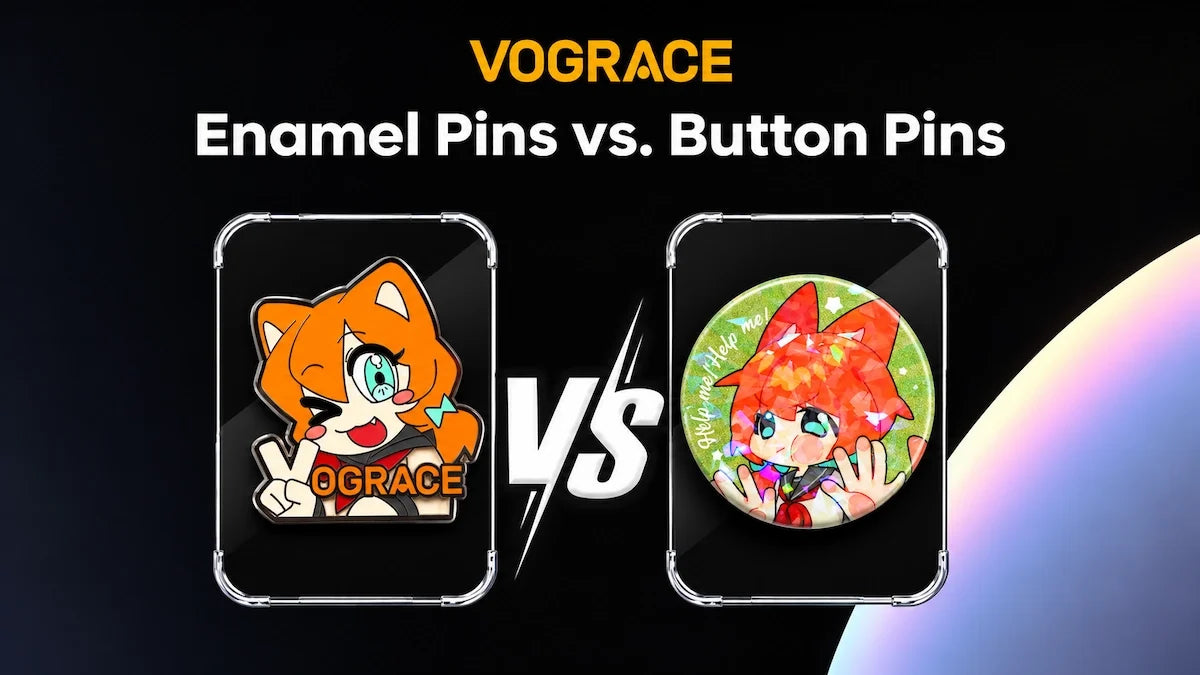
Enamel pins and button pins can often look similar at a glance, but they are built very differently. Button pins carry full-color printed art on a light metal disc. Enamel pins are shaped metal with color-filled sections. That one difference decides cost, detail, and feel.
Three things matter when choosing between these pins: your artwork, your budget, and what the pin is for. Pick wrong, and you will end up overpaying or losing detail in your art. This guide compares both types side by side. You'll also find a simple way to decide between the two, so you can order with confidence.
How Enamel Pins Work

An enamel pin starts as a metal mold. The design is pressed or cast into metal, which creates raised lines and small indented areas. Colored enamel then fills those areas. The raised metal lines keep each color neatly apart.
The finish depends on the type. Soft enamel leaves the color slightly below the metal lines, so you can feel the texture, while hard enamel is filled level with the metal and polished smooth. Plating adds another layer of style, with gold, silver, black, and antique options.
The shape of an enamel pin follows your artwork. A fox can be fox-shaped, and a logo can keep its own outline. Most designs work well at about 1 to 1.25 inches. Detailed characters often look better at 1.5 inches or larger.
Many artists choose custom enamel pins when they want a pin that feels special. The metal edges and shiny color give it weight that print alone cannot match.
How Button Pins Work

A button pin is a printed design sealed under a thin protective film. The print sits on a light tinplate disc, and a pin back holds it to clothing or bags.
Printing is the big advantage here. The print reproduces gradients, shading, photos, and small text with ease. You are not stuck with flat color areas.
Button pins are not only round. Shapes include hearts, stars, squares, and cat ears too. Finishes include glossy, holographic, glitter, foil, and glow-in-the-dark. Round buttons usually start at 25 mm for simple icons and reach 75 mm for large illustrations.
A single design can also come in several shapes, so one illustration can become a whole set. That mix of detail and low cost suits artists with busy, colorful art.
Enamel Pins vs. Button Pins: Side-by-Side Comparison
Here is the quick view. The sections after the table explain the rows that matter most in detail.
|
Feature |
Enamel Pins |
Button Pins |
|
Made from |
Shaped metal with enamel fill |
Printed art on a tinplate disc |
|
Look and feel |
Raised lines, glossy color |
Flat, full-color print |
|
Best artwork |
Bold, flat color areas |
Gradients, photos, fine detail |
|
Typical size |
About 1 to 1.25 inches |
25 to 75 mm |
|
Cost per piece |
Higher |
Lower |
|
Finish options |
Soft or hard fill, plating, glitter, glow |
Glossy, holographic, glitter, foil |
|
Backing |
Clutches or magnets |
Safety-pin style |
|
Best for |
Keepsakes and premium sets |
Volume and detailed art |
How Your Artwork Decides the Winner
Start with your art. It often makes the choice a whole lot easier for you.
Enamel works best with solid color areas split by thin metal lines. Those lines must be wide enough to keep each color apart. Gradients, see-through effects, and fine detail are hard to fill with enamel. A UV print step can help, but it also raises the price.
Button pins have no such limits. The printer lays down color just as your file shows it. A soft watercolor or a photo-style portrait comes out clean. Small text is another test. Tiny lettering can blur in enamel, but it prints crisply on a button.
So try a quick test. If your design uses flat colors and bold outlines, lean toward enamel. But if it uses shading or small details, lean toward buttons.
File prep differs too. Button pins want a high-resolution CMYK file to get the colors right. Enamel pins need clearly marked color areas, and Pantone numbers help when color matching matters.
Cost and Order Size
Button pins cost less per piece. Size, shape, and extras like glitter or foil all move the price. A bigger pin simply uses more material.
Enamel costs more because it has more steps. First, a mold is made, the metal is plated, the color is filled in, and the surface is finished.
Your finish choice also decides the price. To see the difference between soft and hard enamel pins, read our full guide. In short, soft enamel tends to cost less, while hard enamel looks smoother.
If you're ordering from us, the order size is flexible for both. We offer a very low MOQ for both enamel pins and many button pin styles too. That lets you test a design before a bigger run. Larger orders also bring volume discounts, so the price per piece drops as quantity grows.
Durability, Backings, and Care
Both types hold up really well with basic care. They just show signs of use in different ways.
Enamel pins have a metal body and a polished fill, so scratches are rare. Their weak spots are usually bent posts and lost clutches. Check the clutch now and then, as a loose one is a common reason pins go missing.
Button pins are light, and the film shields the print. Their weak spots are bent edges and a worn pin back. Avoid packing them tightly in a bag.
Backings differ too. Enamel pins often use butterfly or rubber clutches, and some also use magnets. Button pins use a safety-pin-style back in most cases.
Which One Should You Choose?
Let your situation decide the choice between enamel pins and button pins. Both types have their own strengths and suit different needs. Each wins in the right setting.
Selling at a convention table: Offer both. Buttons are easy buying decisions, and enamel pins draw collectors.
Handing out pins at an event: Pick buttons. You get more pieces for your budget, and the print shows your art clearly.
Launching a collector drop: Pick enamel. The metal finish makes a limited run feel more special.
Printing detailed fan art: Pick buttons. Shading and small details stay sharp.
Promoting a brand with a simple logo: Pick enamel. Clean lines and plated metal look polished.
You can also sell both pins. Buttons can be priced low and become an easy first buy. You can then feature enamel pins as the premium piece. Fans start with a button, then return for the enamel.
Still unsure? Ask three questions. What does my art look like? How much can I spend per piece? How many do I need? Revisit the side-by-side comparison table, and your answers will point you to the right pin.
Final Thoughts

At the end of the day, the best pin depends on your art and your goal. Both types shine when matched to the right job.
We make both. Vograce button pins come in sizes from 25 to 75 mm, with finishes like holographic, glitter, and foil. Enamel pins come in soft, hard, glitter, and glow-in-the-dark styles. Start with a single piece to test your design, and then scale up once you love the result.