7 Best ACGGOODS Alternatives for Artists and Creators
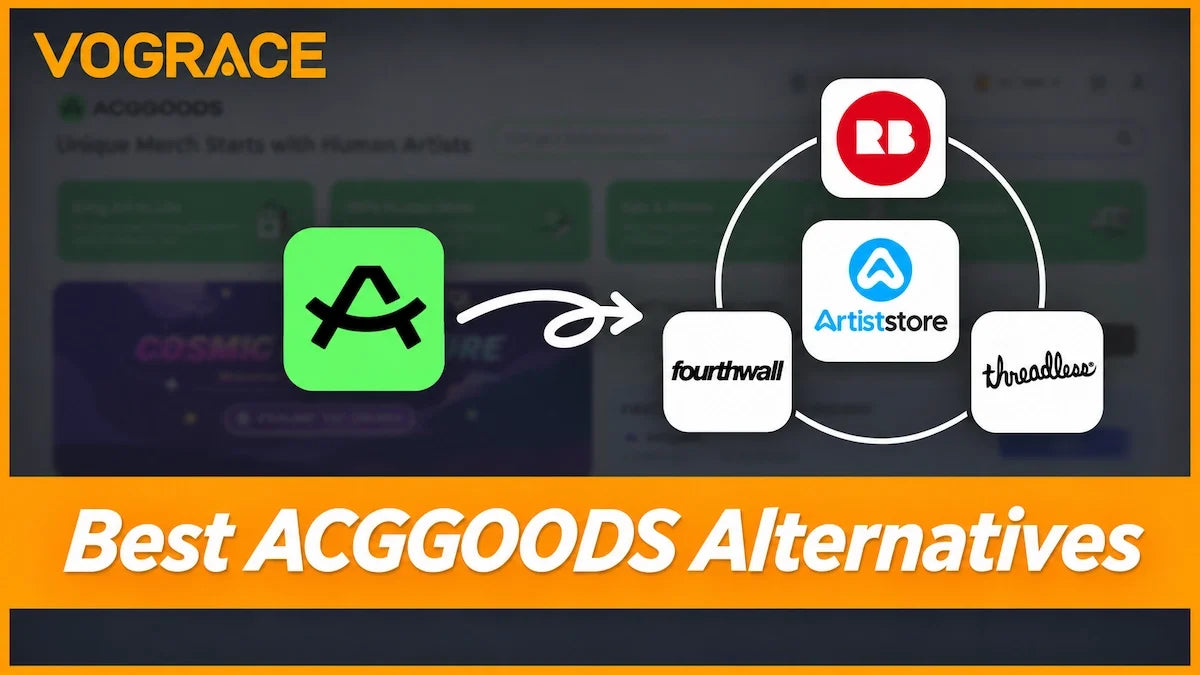
ACGGOODS makes it possible to turn original character art into made-to-order merch without stocking a pile of keychains at home. It also offers YCH (Your Character Here) merch commissions and interactive Merch Maker products—features that go beyond a typical print-on-demand shop.
Still, the right selling platform depends on what you make. Some artists want a storefront they can brand, others want marketplace shoppers to discover their work, and some need a place to take commissions or sell digital files. These seven ACGGOODS alternatives cover those different priorities. None is the right fit for every artist.
ACGGOODS Alternatives at a Glance
|
Platform |
Best fit |
Who handles physical orders? |
Selling model |
|
Artiststore |
Art merch and branded stores |
Platform (POD) |
Free store; optional marketplace |
|
Fourthwall |
Creator brands and mixed products |
Platform for catalog items |
Independent store |
|
Threadless |
Illustrations on everyday merch |
Platform (POD) |
Artist Shop + optional marketplace |
|
Redbubble |
Marketplace exposure |
Platform (POD) |
Marketplace |
|
TeePublic |
Simple, design-led merch |
Platform (POD) |
Marketplace |
|
Spreadshop |
Apparel and fan merch |
Platform (POD) |
Independent merch shop |
|
Ko-fi |
Commissions and digital work |
Creator for physical goods |
Creator page + shop |
A free account does not mean every sale is fee-free. Compare production or base costs, platform fees, payment processing, shipping, and payout rules before setting prices.
1. Artiststore — Best for Artist-Designed Physical Merch

Artiststore is a print-on-demand platform built for artists who want to turn their illustrations into physical merchandise. Its product range includes acrylic keychains, standees, pins, stickers, prints, apparel, and home goods. Artists can create their own branded storefronts, while production, shipping, and after-sales support are handled through the platform, backed by Vograce's manufacturing experience.
Unlike marketplaces that set fixed royalties, Artiststore lets creators choose their retail prices. There are no monthly fees, listing fees, or platform commissions. Customer payments go directly to the seller's connected Stripe or PayPal account, while production and shipping costs are charged when orders come in. Standard payment-processing fees may still apply.
Strengths
· Artist-focused product selection, particularly acrylic merchandise, stickers, pins, and character-themed accessories.
· No upfront inventory investment, with on-demand manufacturing, shipping, and after-sales support.
· Independent storefront customization, flexible retail pricing, and Shopify integration.
· Optional access to the Artiststore Marketplace, providing another potential channel for product discovery.
Trade-offs
· Marketplace participation requires approval, and opening a store does not guarantee traffic or sales.
· Sellers need a supported payment account and a billing card to cover fulfillment costs. Artists must also promote their stores to attract customers.
Best for: Independent illustrators, character artists, and merch creators who want to sell acrylic keychains, standees, stickers, pins, and other physical products without managing inventory.
For artists with a collection of illustrations ready to become merchandise, Artiststore offers a way to start selling without handling production themselves. Interested creators can apply to open a free Artiststore shop. Applications are reviewed before accounts are activated.
2. Fourthwall — Best for a Creator Brand Beyond Merch

Fourthwall offers a customizable storefront for physical merchandise, digital products, memberships, and products you source yourself. Its catalog products can be made on demand, and the platform manages manufacturing, shipping, and customer support for those orders.
The free plan has no monthly charge. Catalog items have a stated product cost that comes out of the selling price; digital products and memberships carry separate fees on the free plan, and payment-processing fees can apply.
Strengths
· One storefront can combine merch with digital downloads, memberships, and separately sourced products.
· Strong shop branding tools and integrations aimed at creators who already speak to fans on social platforms.
· No requirement to keep inventory for products fulfilled from the Fourthwall catalog.
Trade-offs
· It is not primarily a built-in shopping marketplace, so attracting buyers is largely up to the creator.
· Its broad creator catalog is not a one-to-one replacement for ACGGOODS’ YCH-to-physical-merch workflow; check each product format before moving a design.
Best for: YouTubers, streamers, illustrators, and other creators who want merch alongside digital products or paid communities.
3. Threadless — Best for Illustrations Across Everyday Products

Threadless Artist Shops lets artists open free shops and place designs on apparel, prints, accessories, and home goods. Threadless handles printing, shipping, and customer service. Shop owners can set prices or choose managed pricing and promotions.
It also offers a route into the Threadless Marketplace, but inclusion is curated rather than guaranteed. Importantly, earnings differ by channel: Artist Shop sales use the net selling price minus a base fee, while Marketplace sales pay a royalty under a separate formula.
Strengths
· Free, branded Artist Shops without an inventory commitment.
· A good fit for designs that translate well to shirts, art prints, and lifestyle merchandise.
· Potential discovery through the separate Threadless Marketplace when eligible designs are selected.
Trade-offs
· Shop earnings include a product cost and a processing component in the base fee; Marketplace payouts follow a different royalty rate.
· It is less specialized in custom acrylic character merch and interactive YCH commissions than ACGGOODS.
Best for: Illustrators who want to see how the same design performs on prints, clothing, and everyday goods while maintaining a dedicated shop.
4. Redbubble — Best for Testing Marketplace Demand

Redbubble is a print-on-demand marketplace where artists upload artwork for products such as stickers, shirts, phone cases, mugs, and wall art. Buyers can browse and search designs within Redbubble, while printing and delivery happen through its fulfillment network.
Opening an artist shop is free, but seller earnings are affected by account tiers and fees. Under Redbubble’s July 2026 fee policy, Standard accounts pay a 50% platform fee on monthly gross artist earnings, Premium accounts pay 20%, and Pro accounts pay no platform fee; caps and excess-markup rules also apply. These percentages are not percentages of the customer’s full purchase price.
Strengths
· Built-in marketplace browsing gives artists a potential route to customers beyond their existing followers.
· Straightforward product setup with no inventory, packing, or shipping to manage.
· Useful for testing which illustrations or themes attract attention across common gift products.
Trade-offs
· Tier-based fees can materially reduce take-home earnings; search visibility and sales are not guaranteed.
· Your brand lives inside a shared marketplace, with less control over the overall customer experience than in a stand-alone store.
Best for: Artists who prefer listing on an established marketplace and are willing to trade some pricing and brand control for potential discovery.
5. TeePublic — Best for Simple Graphic Merch

TeePublic is a design marketplace centered on graphic apparel, stickers, posters, phone cases, mugs, and other everyday products. The basic workflow is simple: upload a design, enable products, and let the platform handle production and delivery.
Rather than letting artists choose their own margin on each item, TeePublic publishes fixed artist earnings by product and whether the item is on sale. It also classifies accounts as Artisan or Apprentice; according to TeePublic, only Artisan accounts are eligible to appear in on-site search.
Strengths
· Low-maintenance setup and fulfillment, especially for graphic tees and stickers.
· Published earnings charts help artists see the payout for each type of sale.
· Marketplace format suits creators who would rather upload designs than build a complete storefront.
Trade-offs
· Fixed per-item earnings leave less room to experiment with your own price and margins.
· Account category affects on-site search eligibility, and specialty acrylic products or YCH workflows are not its focus.
Best for: Artists with bold, repeatable graphic designs who want a straightforward marketplace listing process.
6. Spreadshop — Best for Apparel-Led Fan Merchandise

Spreadshop helps creators build free merch stores, particularly for T-shirts, hoodies, sweatshirts, mugs, hats, and other fan products. You add a design and choose a selling price; Spreadshop prints, ships, and handles customer service for orders.
The shop has no setup or monthly fee, and no minimum order. Earnings are the selling price above the relevant base price, with payouts handled on the platform’s payout schedule and subject to its requirements.
Strengths
· Easy to launch apparel-focused collections without upfront inventory or production work.
· Independent shop presentation, with options to share or embed your merch shop in other channels.
· Price-setting flexibility and clear base-price logic for estimating a margin.
Trade-offs
· Its standout products are apparel and standard merchandise, not custom acrylic standees or character-focused accessories.
· A Spreadshop itself should not be confused with a buyer-discovery marketplace; most sellers still need to bring an audience.
Best for: Creators, bands, community organizers, and artists whose fans mainly want clothing and familiar branded gifts.
7. Ko-fi — Best for Commissions, Downloads, and a Small Shop

Ko-fi is different from the other options on this list. It combines a creator page with tips, memberships, commissions, and a shop for digital or physical products. You can list a custom illustration commission and sell an art download alongside a small collection of merch.
A Ko-fi page can be opened without a monthly subscription. Its standard shop and commission transactions carry a 5% service fee, plus payment-processing fees. For physical items, creators arrange production, packaging, shipping rates, and fulfillment themselves or work with an outside supplier.
Strengths
· Especially useful for artists taking individual commissions or offering digital files, tutorials, and supporter extras.
· Simple links to products and commission listings that can be shared directly with followers.
· Direct PayPal or Stripe payments rather than waiting for a scheduled platform payout.
Trade-offs
· Ko-fi is not an integrated print-on-demand manufacturer; selling physical merchandise adds a fulfillment task.
· Its commission tools do not automatically turn a YCH design into a manufactured merch order the way ACGGOODS’ dedicated flow can.
Best for: Commission artists, digital illustrators, and creators who sell relatively few physical items or already have a production partner.
Which ACGGOODS Alternative Should You Choose?
Start with the product you actually want to sell—not the platform with the longest feature list. A beautifully designed shop is not much use if it cannot make the acrylic charm your audience keeps asking for.
|
Your priority |
A practical starting point |
|
Acrylic keychains, pins, stickers, standees |
Artiststore — check product formats, costs, and sample quality. |
|
A branded store with digital products or memberships |
Fourthwall — useful for mixed creator offerings. |
|
Prints, apparel, and a possible curated marketplace |
Threadless — compare Shop and Marketplace earnings. |
|
Marketplace browsing for many art designs |
Redbubble — calculate tier fees first. |
|
Quick graphic tee and sticker listings |
TeePublic — review account category and fixed payouts. |
|
Clothing-first community merchandise |
Spreadshop — price products against the base cost. |
|
Art commissions and digital downloads |
Ko-fi — plan physical-order fulfillment separately. |
If your work relies on personalized YCH requests, do not assume another platform reproduces ACGGOODS’ commission-to-merch process. You may need a separate commission tool and a fulfillment partner—or decide that staying with ACGGOODS for that part of your work makes more sense.
Before You Switch, Check the Numbers
Compare one actual order rather than platform slogans. Use the same product size, quantity, destination, and retail price in every estimate:
|
Check |
Why it matters |
|
Product + production cost |
A “free store” can still have substantial per-order manufacturing costs. |
|
Shipping and processing |
The buyer-facing price and the artist’s net earnings are not the same. |
|
Payout and billing timing |
Some platforms hold and pay earnings later; others charge fulfillment costs to your card. |
|
Traffic and customer relationship |
A marketplace may provide discovery, but a stand-alone store offers a different brand experience. |
|
Artwork and product rights |
Original art is not automatically licensed for commercial fan merch. |
Order a sample of your flagship item, check the shipping policy for your largest customer region, and keep your social links current before moving a full collection. You can also test a second channel without abandoning a store that already works.
The Bottom Line
The best ACGGOODS alternative is the one that fits your work and how your audience shops. Choose Artiststore if you want a merch-focused, on-demand store for illustrated accessories; Fourthwall if you sell several kinds of creator products; or Redbubble and TeePublic if marketplace exposure matters most. Threadless and Spreadshop are strong options for designs that work on apparel and prints, while Ko-fi suits commissions and downloads.
For artists building a collection around stickers, acrylic keychains, pins, and standees, explore Artiststore and compare a real product quote before making the move. Your best platform should make selling the art you already love creating easier—not force you into a product category that does not fit.
Frequently Asked Questions
What is the closest ACGGOODS alternative for acrylic artist merch?
Artiststore is one of the more directly comparable options for physical art merch because it supports products such as keychains, standees, pins, and stickers with on-demand production. That does not mean it duplicates ACGGOODS’ YCH commissions or interactive Merch Maker features.
Which alternatives can sell products without inventory?
Artiststore, Fourthwall, Threadless, Redbubble, TeePublic, and Spreadshop offer print-on-demand fulfillment for supported products. Ko-fi can list physical items, but it does not manufacture and ship them for you.
Which options have a built-in marketplace?
Redbubble and TeePublic are marketplace-led, though visibility depends on platform rules. Threadless provides an optional, curated marketplace route. Artiststore allows sellers to apply to join its own Marketplace. Fourthwall, Spreadshop, and Ko-fi primarily rely on the creator bringing shoppers to their store or page.
Are these free ACGGOODS alternatives actually free?
Most offer a free way to get started, but “free” usually means no initial store subscription or inventory purchase. Product base costs, platform fees, payment-processing charges, shipping, and withdrawal requirements vary. Always calculate net earnings for the item you intend to sell.
Can I sell fan art or character merchandise on these sites?
You generally need the rights or permission required to sell any artwork or character design commercially. A platform accepting an upload does not grant a license from the original copyright or trademark owner. Check the platform’s IP policy and the relevant rights holder’s rules before listing fan merchandise.