Pin Size Chart & Guide: Standard Sizes & How to Choose
Choosing a pin size sounds simple until you see your artwork at its actual physical size. A design that looks spacious on a monitor can feel crowded at one inch, while a large pin can overwhelm a jacket or bag when the artwork itself is fairly simple.
The right size depends on the type of pin, the amount of detail in your design, and where you plan to wear or display it. This guide covers common enamel, lapel, and button pin sizes, with practical recommendations for artists and creators.
Pin Size Chart: Common Sizes at a Glance
There is no single standard size that works for every pin, but a few dimensions appear frequently across custom pin production.
|
Pin Size |
Approx. Metric Size |
Common Use |
Best For |
|
0.5” |
13mm |
Small enamel/lapel pins |
Tiny symbols, simple icons |
|
0.75” |
19mm |
Small enamel/lapel pins |
Logos, minimalist artwork |
|
1” |
25mm |
Enamel pins, small button pins |
Everyday pins, simple characters |
|
1.25” |
32mm |
Enamel pins, button pins |
Character art, artist merch |
|
1.5” |
38mm |
Enamel pins |
Detailed artwork, collectibles |
|
1.75” |
44mm |
Large enamel/button pins |
Larger illustrations and merch |
|
2” |
51mm |
Large enamel pins |
Detailed or statement designs |
|
2.25” |
57–58mm |
Button pins |
Illustrations, characters, readable text |
|
3” |
75–76mm |
Large button pins |
Full artwork and statement designs |
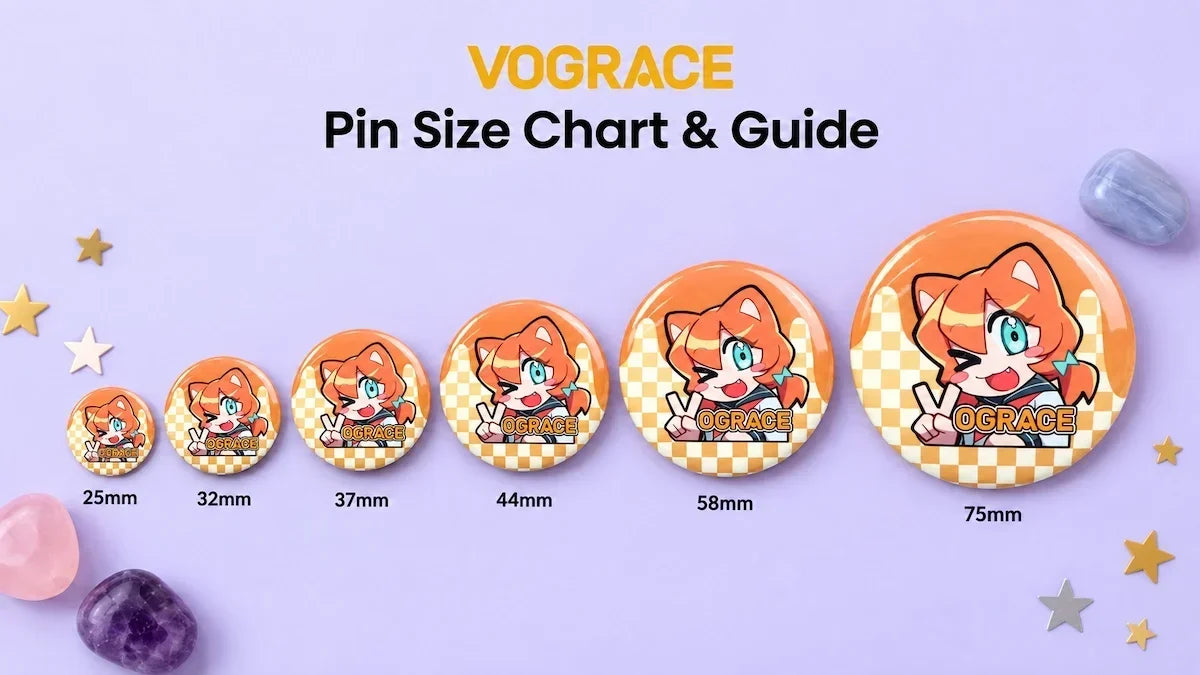
These are reference sizes rather than strict rules. Custom enamel pins can be produced outside these ranges, while round button pins are often offered in fixed diameters. Vograce’s current round button pin options, for example, include 25, 32, 37, 44, 58, and 75mm.
For enamel and lapel pins, sizes around 0.75–1.25 inches are commonly used, while artist and collectible designs often move toward 1.25–2 inches as artwork becomes more detailed.
What Is the Standard Pin Size?
There is no universal standard pin size.
For enamel and lapel pins, 1–1.25 inches is a practical starting range for most logos, mascots, and simple character designs. Smaller 0.5–0.75-inch pins suit minimal artwork, while detailed designs often benefit from 1.5 inches or more.
Button pins use a different sizing range, with common diameters such as 32mm, 44mm, 58mm, and 75mm.
The best size ultimately depends on your artwork, level of detail, and intended use.
How Pin Size Is Measured
Pin size is usually based on the longest dimension of the finished piece.
For example, a pin measuring 1.5 inches tall by 1 inch wide is considered a 1.5-inch pin. Irregular-shaped pins are measured from the two farthest points along their longest direction, while round button pins are measured by diameter.
Always measure the complete finished shape, including borders or outer edges—not just the printed artwork.
Enamel and Lapel Pin Sizes

Enamel and lapel pin sizes overlap heavily. In practice, “lapel pin” often describes how a pin is worn, while “enamel pin” refers more specifically to its construction and finish.
For most projects, it makes more sense to choose the size according to the artwork and intended use rather than treating lapel and enamel pins as completely separate sizing systems.
Small Pins: 0.5–0.75”
Pins between 0.5 and 0.75 inches are compact and understated.
They work especially well for:
· Simple logos
· Hearts, stars, symbols, and icons
· Small brand marks
· Minimal line art
· Coordinated pin sets
· Subtle lapel or collar accessories
The trade-off is limited design space. Small text, facial features, thin outlines, or closely packed color areas may become difficult to manufacture clearly or see at normal viewing distance.
A small pin works best when the artwork has a strong silhouette and very few tiny elements.
Standard Pins: 1–1.25”
For many custom enamel pin projects, 1 to 1.25 inches offers the best balance between detail, visibility, and everyday wearability.
This range is a good fit for:
· Mascots
· Simple character designs
· Artist merchandise
· Brand logos
· Chibi characters
· Small illustrations
· Backpack and jacket pins
A one-inch pin can comfortably handle relatively simple artwork. Moving closer to 1.25 inches gives character faces, accessories, and smaller color areas more space.
This is also where thinking in pixels can be misleading. A character illustration may look incredibly detailed at 2000 pixels wide on your screen, but the final object could be only 25–32mm across. Features such as eyelashes, jewelry, tiny lettering, or narrow strands of hair may need to be simplified.
Manufacturing limits matter too. For example, Vograce’s current soft enamel design guidelines call for lines around 0.3mm, edge lines around 0.2mm, and sufficiently wide areas for enamel coloring. Exact requirements can vary by design and process, which is why artwork should always be evaluated at its intended physical size.
Large Pins: 1.5–2”+
Once you reach 1.5 inches and above, there is significantly more room to preserve artwork.
This range works well for:
· Detailed character designs
· Full-body characters
· Complex costumes and accessories
· Multiple visual elements
· Collector pins
· Limited-edition artist merch
· Larger text-and-art combinations
· Display-focused designs
Around 1.5 inches is often a comfortable choice when a character’s face or clothing details are important to the design. At 2 inches and beyond, pins become much more noticeable and begin to feel more like statement collectibles.
Bigger is not automatically better, though. Large enamel pins use more material, weigh more, and may feel less comfortable on lightweight clothing. A large pin that looks great on a denim jacket or pin board may not be ideal on a thin shirt collar.
Button Pin Sizes

Button pins deserve their own size range because their construction and visual layout are different from enamel pins.
Most traditional button pins use a printed circular face over a metal or plastic-backed structure. Because almost the entire circle can carry printed artwork, button pins are especially useful for illustrations, character portraits, photographs, slogans, and designs with backgrounds.
Vograce currently offers standard round button pin diameters of 25, 32, 37, 44, 58, and 75mm.
Small Button Pins: 25–37mm
Button pins from 25 to 37mm are compact and easy to add to bags, jackets, pouches, or merchandise sets.
They work well for:
· Character faces
· Simple icons
· Logos
· Small mascots
· Short words
· Coordinated badge sets
At 25mm, keep the design especially simple. A detailed illustration squeezed into a one-inch circle can quickly lose readability.
The 32–37mm range offers more room while still keeping the finished button small and lightweight.
Medium Button Pins: 44–58mm
For many artist and creator projects, 44–58mm is a particularly versatile button pin range.
There is enough surface area for:
· Character portraits
· Detailed illustrations
· Artist Alley merchandise
· Original character collections
· Short text combined with artwork
· Ita bag layouts
· Backpack accessories
· Promotional artwork
A 58mm button provides much more visible printed space than a typical one-inch enamel pin, making it a useful choice when preserving the original composition matters.
This is often the range to consider when you want the artwork itself—not the pin hardware—to be the main attraction.
Large Button Pins: 75mm
A 75mm button pin is difficult to miss.
This size works best for:
· Full character illustrations
· Large portraits
· Detailed artwork
· Bold slogans
· Statement accessories
· Collector displays
· Large ita bag arrangements
The extra space allows more of the original artwork to remain intact, but it also creates a much stronger visual presence. A 75mm button can look great on a bag or display, while feeling oversized on a collar or small hat.
Use this size when being noticeable is part of the design.
How to Choose the Right Pin Size
A size chart gives you a starting point, but the artwork should make the final decision.
Three things matter most: what the artwork contains, how the shape uses space, and where the finished pin will go.
Match the Size to Your Artwork
Simple artwork can usually go smaller.
A bold cat silhouette with two colors may work perfectly at 0.75–1 inch. A character with detailed eyes, earrings, layered clothing, hair accessories, and lettering probably needs more space.
A useful way to think about it is:
|
Artwork Type |
Good Starting Range |
|
Minimal symbol |
0.5–0.75” |
|
Simple logo |
0.75–1” |
|
Mascot or simple character |
1–1.25” |
|
Detailed character |
1.25–1.5” |
|
Complex collector artwork |
1.5–2”+ |
These are starting points, not production rules. Two designs with the same number of colors can still require very different sizes.
Before increasing the pin size, also ask whether every tiny element actually needs to stay. Simplifying a few lines can sometimes produce a cleaner pin than simply making everything larger.
Consider Shape and Fine Details
Pin size alone does not tell you how much usable visual space you have.
A round 1.25-inch design uses space very differently from a tall, narrow 1.25-inch character. Wide wings, long swords, animal ears, tails, or extended poses can increase the longest dimension without giving the central face or body much extra room.
Pay particular attention to:
· Eyes and mouths
· Thin hair strands
· Fingers
· Small accessories
· Fine outlines
· Closely spaced colors
· Tiny lettering
If those elements matter to the character, give them enough physical room.
For enamel pins in particular, adjacent enamel colors normally need metal separation. Very small gaps and thin decorative lines may therefore need adjustment even when they look perfectly clear in the original digital artwork.
Think About Where You’ll Wear It
The same design can feel completely different depending on where it is placed.
|
Placement |
Size Direction |
|
Collar or lapel |
Small to medium |
|
Hat |
Small to medium |
|
Shirt |
Small and lightweight |
|
Jacket |
Medium to large |
|
Backpack |
Medium to large |
|
Ita bag |
Medium to large |
|
Pin board |
Almost any size |
|
Collector display |
Medium to oversized |
A subtle 0.75-inch pin can look polished on a lapel but get lost on a large backpack. A two-inch collector pin may look perfect on a display board but pull noticeably on thin fabric.
Think about the final environment, not just the product photo.
How Pin Size Affects Weight and Cost
Increasing pin size usually increases the amount of material required, especially for metal enamel pins. A larger pin can therefore become both heavier and more expensive to produce.
The effect is not based on size alone. Final pricing can also depend on:
· Quantity
· Material
· Soft or hard enamel
· Plating
· Number of colors
· Special effects
· Cutouts
· Moving parts
· Backing options
· Overall design complexity
Large or wide enamel pins may also need additional pin posts or stronger backing placement to stay level when worn. GS-JJ similarly notes that larger pins can require additional clutches and may feel less stable on lightweight fabrics.
Button pins behave somewhat differently because their construction is thin and their artwork is printed rather than built from filled metal areas. Still, a 75mm button naturally takes up much more space than a 25mm one, so placement and comfort should still be considered.
If cost is important, avoid choosing a larger size simply because it sounds more premium. The best value usually comes from using the smallest size that still keeps the important parts of the artwork clear.
Test Your Pin Size Before Ordering

One of the easiest ways to avoid choosing the wrong size is to test your design at full scale before production.
First, place several versions of your artwork on one page—for example, 1”, 1.25”, 1.5”, and 2”.
Print the page at 100% scale with options such as “Fit to Page” turned off. Check the result with a ruler to make sure the printer has not resized it.
Then cut the shapes out and place them where the real pins will go:
· On a jacket
· On a backpack
· On a hat
· Inside an ita bag
· Beside other pins in your collection
The difference between 1 and 1.5 inches becomes much easier to understand when you see it physically.
Finally, look at the smallest important parts of your design. Can you still recognize the eyes? Is the text readable? Are several thin lines turning into one dark area?
If the answer is no, you have two good options: make the pin larger or simplify the artwork.
Testing a paper version takes only a few minutes and can save you from discovering a sizing problem after production.
Quick Pin Size Recommendations
If you just want a practical starting point, use this chart:
|
Design or Use |
Recommended Starting Size |
|
Tiny icon or symbol |
0.5–0.75” |
|
Simple lapel logo |
0.75–1” |
|
Standard logo or mascot |
1–1.25” |
|
Character enamel pin |
1–1.5” |
|
Detailed character artwork |
1.25–1.5” |
|
Collector enamel pin |
1.5–2”+ |
|
Small button icon |
25–37mm |
|
Character button pin |
44–58mm |
|
Standard artist merch button |
44–58mm |
|
Large illustration button |
75mm |
When in doubt, choose according to the smallest detail you need to preserve, not simply the overall width of the original artwork.
Pin Size FAQs
What Is the Most Common Enamel Pin Size?
There is no single standard, but 1–1.25 inches is a common and versatile range for everyday enamel pins. Detailed artist pins often move closer to 1.25–1.5 inches.
Is a 1-Inch Pin Too Small?
No. One inch is a good size for logos, icons, mascots, and relatively simple characters. It can become too small when the artwork contains tiny text or many fine details.
Is a 2-Inch Pin Too Big?
Not for every use. A two-inch pin works well for detailed artwork, collector pins, jackets, bags, and displays. It may feel heavy or visually oversized on thin clothing or a small lapel.
What Is the Standard Button Pin Size?
There is no universal standard button size. Common diameters include roughly 25–75mm. Vograce’s round button pins are currently available in 25, 32, 37, 44, 58, and 75mm sizes.
Are Button Pins Bigger Than Enamel Pins?
They often are in typical merchandise use, but they do not have to be. Button pins are commonly produced in larger round diameters, while enamel pins often use smaller custom shapes.
Are Lapel Pins and Enamel Pins the Same Size?
Their size ranges often overlap. “Lapel pin” usually refers to a pin designed to be worn on a lapel, while enamel describes a common manufacturing style. Traditional lapel pins tend to stay relatively small, but custom enamel pins can be much larger.
How Do You Measure an Irregular-Shaped Pin?
Measure the finished design along its longest edge, from the two farthest points. Include the complete outer shape rather than measuring only the printed or colored area.